
A Cooperative of Place, People & Purpose
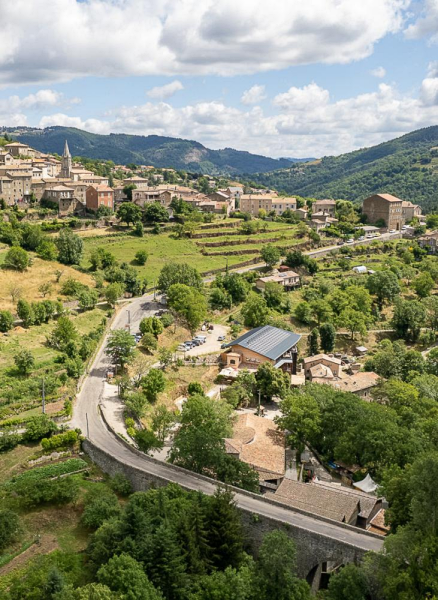
Nestled in the mountainous heart of France’s Ardèche region, the cooperative SCOP Ardelaine emerged in 1982 as a bold response to economic decline, rural exodus and the erosion of local industry. Founded on the site of a former wool-spinning mill in the village of Saint-Pierreville, Ardelaine set out to reclaim a local resource,the wool of regional sheep,and to turn it into a socially-just, ecologically-grounded enterprise.
From Fleece to Fabric: Crafting Local Value
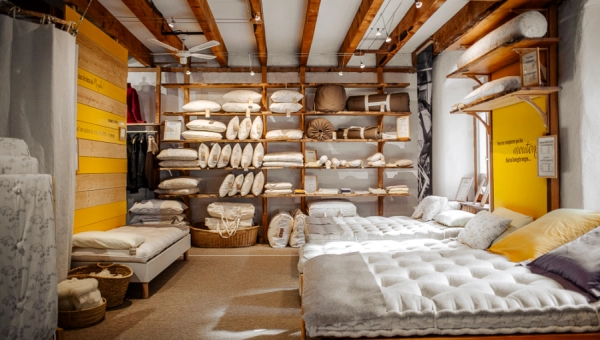
In the early years, the cooperative focused on reviving the wool supply chain: sheep shearing, sorting, washing, carding, spinning, and finally producing mattresses, duvets, blankets, garments and children’s textiles,all from local fleece. The conscious choice to work in short circuits (circuit-court), processing wool locally and selling directly to consumers, remains central. By anchoring production in-house and region-based, Ardelaine kept value in the territory, prevented depopulation, and offered meaningful employment in a remote area.
A Cooperative Model That Lives Its Values
What makes Ardelaine distinctive is not only what it produces, but how it is governed. From the outset the enterprise chose the SCOP (Société Coopérative et Participative) model, in which employees are also co-owners: they hold the majority of capital, they elect their management, and decisions are made democratically,one person, one vote.
In Ardelaine’s own words:
“Dans une SCOP … les salariés sont les associés majoritaires et [...] les décisions stratégiques sont l’expression du plus grand nombre.”
Profit-sharing also reflects the cooperative ethos: at Ardelaine, when there is surplus, 45 % goes to all employees, 45 % into reserves for the enterprise’s sustainability, and 10 % to shares held by the co-owners. Salaries are tightly ranged (a ratio of about 1.2 between highest and lowest) to reflect respect, complementarity and mutual trust rather than hierarchical divide.
Territory, Heritage and Regeneration
Ardelaine is more than a factory; it is a territorial cooperative. Set in the Parc Naturel Régional des Monts d’Ardèche, the site draws thousands of visitors annually to its museum of wool, guided tours, creative workshops, café-bookstore and shop of pure-wool products. By repurposing a former industrial site in a remote rural region, Ardelaine contributed to local regeneration,creating jobs, revitalising the village, embracing tourism, and strengthening links between craft, ecology and community.
Why “Vive le Collectif”?
Ardelaine’s narrative is grounded in the belief that cooperation is not just an economic form but a cultural practice. In the section titled “Vive la coopération!”, the cooperative lays out the cooperative principles it embraces: voluntary and open membership, democratic control by members, economic participation, autonomy and independence, education/training, cooperation among cooperatives, and concern for community. These are not abstract ideals: at Ardelaine they have concrete consequences. Decisions are transparent, management is collegially elected, capital is fixed so the enterprise cannot be subject to speculative takeover, and the mission is centred on remettre l’économie au service de l’humain (“placing the economy back at the service of humanity”).
The Cooperative Movement in Action
Walking through the workshops, the store, and the museum at Saint-Pierreville, one sees more than wool and machines. One sees a collective culture of work: people who share responsibility, contribute to decision-making, and value the well-being of the whole. The enterprise spans production, retail, tourism, training and territory. It shows that cooperatives can be flexible, diversified and modern, while remaining rooted in local environment and democratic governance. In a world dominated by globalised supply-chains, anonymous capital and remote ownership, Ardelaine stands as a reminder that another way is possible,one where economic activity is embedded in community, where value is shared, where people are owners not just workers, and where ecology, craft and cooperation converge.
Featured Criteria
Criterion 4. Active Cooperative Connection
Sites must either remain in operation as cooperatives or be explicitly dedicated to preserving and interpreting cooperative history.
Criterion 12. Sustainability and Inclusivity
Sites shall embody cooperative values of social and environmental sustainability, including, gender equity, youth engagement, and cultural diversity.
Criterion 13. Networking and International Solidarity
Sites shall connect to cooperative networks—regional, national, and international—participating in exchanges, research, and cooperative tourism to strengthen global cooperative heritage.
Learn More