
A City Built on Solidarity
In the heart of Argentina’s Santa Fe province, surrounded by the green expanse of the Pampas, stands the city of Sunchales,proudly known as the Capital Nacional del Cooperativismo, the National Capital of Cooperativism. More than a city, Sunchales is a living expression of a century-old movement that has shaped Argentina’s rural and economic identity. Its streets, institutions, and monuments bear witness to a lasting belief: that true progress flourishes when communities work together.
The Rise of Dairy Cooperatives
By the late 1920s, as the surrounding region evolved into one of Argentina’s most productive dairy zones, Sunchales witnessed the rise of milk-producers’ cooperatives. The first associations appeared around 1929, bringing local farmers together to process and market their milk collectively. This shift marked the beginning of a profound transformation in the local economy. Over time, these cooperatives expanded into large-scale enterprises. Among the most prominent are SanCor Cooperativas Unidas Ltda., which became one of Argentina’s leading dairy producers, and Grupo Sancor Seguros, now one of the nation’s foremost insurance cooperatives. These organizations not only anchored the city’s economic growth but also embodied its cooperative soul,enterprises built not on profit alone, but on mutual trust and shared prosperity.
The Origins of Mutual Aid
The cooperative spirit in Sunchales began long before Argentina enacted formal laws on cooperation. In 1891, groups of Italian immigrants who had settled in the region founded sociedades de socorro mutuo,mutual aid societies that provided support in times of illness, loss, or need. These small, community-based associations were rooted in solidarity and shared responsibility. They represented the first local expressions of cooperative organization, predating Argentina’s first Cooperative Law of 1926 by more than three decades.
Through these early mutual aid groups, immigrants found not only practical support but also belonging. They created institutions that mirrored their values,mutual help, fairness, and collective progress,and planted the seeds of a cooperative tradition that would come to define Sunchales itself.
A National Recognition
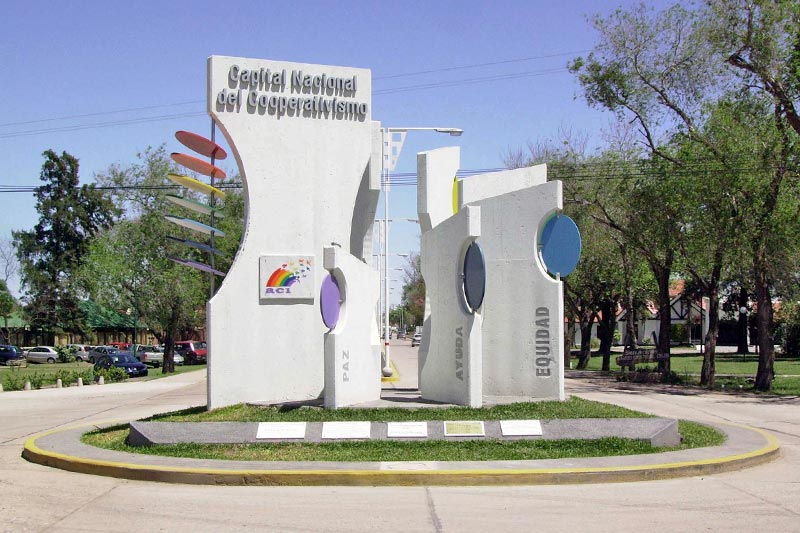
In recognition of Sunchales’ deep cooperative heritage, the Argentine National Congress passed Law 26.037 in 2005, officially designating the city as the Capital Nacional del Cooperativismo. The declaration affirmed what history had already made evident: Sunchales stood as a beacon for cooperative enterprise across Latin America. A year later, in 2006, the city unveiled its most emblematic landmark,the Monumento Nacional al Cooperativismo. Situated at the intersection of Avenida Yrigoyen and General Paz, the monument stands as a striking symbol of the city’s spirit and ideals.
The Monument to Cooperation
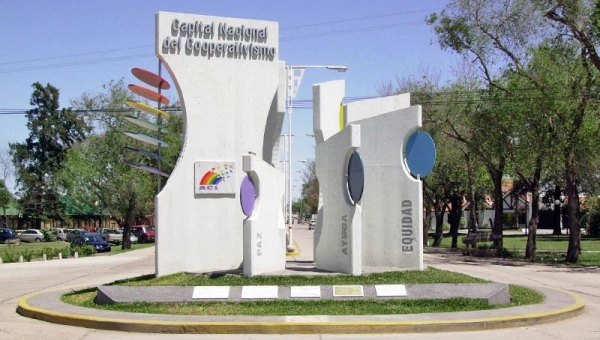
The monument’s design features eight towering concrete pillars, each representing one of the universal principles of cooperation: Peace, Help, Equity, Justice, Freedom, Solidarity, and Responsibility. The eighth pillar, painted in a blend of the others’ colors, symbolizes unity within diversity,a visual reminder that cooperation is not uniformity, but harmony among differences. Beyond its symbolic form, the monument functions as a gathering place for reflection, dialogue, and celebration. Every July, Sunchales hosts national and international events to mark the International Day of Cooperatives, attracting visitors from across Argentina and neighboring countries who come to honor the enduring power of collective action.
Cooperation as a Way of Life
Today, Sunchales’ cooperative values extend well beyond its monument. Cooperative education is woven into local schools, teaching new generations the principles of mutual aid and democratic participation. Youth-led initiatives flourish alongside established enterprises, ensuring that the cooperative ethos remains vibrant and forward-looking. The city’s institutions, from its banks to its cultural centers, continue to reflect a model of shared responsibility. Cooperation here is not merely a historical idea,it is a daily practice, a civic habit, and a cultural inheritance passed from one generation to the next.
A Living Philosophy
Standing before the Monumento Nacional al Cooperativismo, one feels both the weight of history and the promise of renewal. The eight pillars rise like a chorus, their colors blending under the Pampas sky, reminding all who visit that unity and diversity can coexist in pursuit of a common good. Sunchales is not only the capital of cooperativism in name but in essence,a city where the past’s collective struggles meet the future’s shared dreams. It stands as a testament to a simple, enduring truth: that community is humanity’s greatest source of strength.
Featured Criteria
Criterion 1. Historical Significance
Sites must be at least thirty (30) years old, preferably sixty (60), or directly associated with foundational events, milestones, or figures in the cooperative movement.
Criterion 2. Connection to Cooperative Pioneers or Communities
Sites must demonstrate a tangible link to cooperative pioneers, enterprises, federations, or communities that shaped cooperative practice and identity.
Criterion 4. Active Cooperative Connection
Sites must either remain in operation as cooperatives or be explicitly dedicated to preserving and interpreting cooperative history.
Learn More