
Origins of a Movement
In the coastal town of Vadakara, Kerala, stands the headquarters of one of Asia’s most remarkable cooperative enterprises , the Uralungal Labour Contract Co-operative Society (ULCCS). Founded in 1925 by a small group of visionary workers, ULCCS was not born out of wealth or privilege, but out of necessity, unity, and courage.
At the time, colonial India’s rigid social order left labourers at the mercy of exploitation and insecurity. Denied fair wages and dignity, a handful of workers in the village of Uralungal decided that instead of waiting for justice, they would build it themselves.
Guided by the reformist ideals of Vagbhatananda, a local philosopher who championed social equality and cooperative action, they came together to form a labour society that would belong to them, a place where work, ownership, and decision-making were shared.
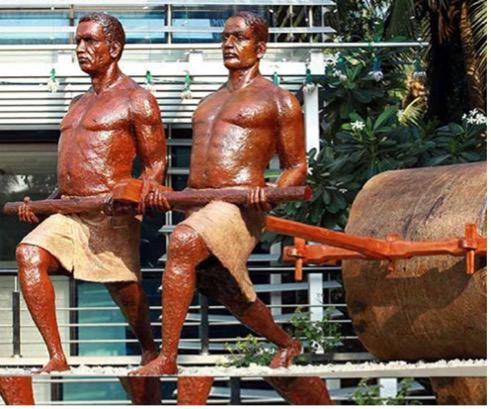
Fourteen men contributed their modest savings and pledged their labour to found ULCCS, adopting a motto both humble and revolutionary: “Work with dignity, share collectively, serve the community.” From its earliest days, the cooperative embodied the spirit of self-help and solidarity, proving that when people unite around shared values, they can turn hardship into opportunity.
From Village Roads to National Landmarks
ULCCS began by taking small public works contracts , repairing roads, constructing culverts, maintaining wells , projects often neglected by private contractors. The society’s commitment to integrity, transparency, and efficiency soon earned the trust of local communities and government bodies alike. What started as a handful of men with basic tools grew steadily into a major civil construction cooperative. Over the decades, ULCCS completed thousands of projects across Kerala and beyond: roads, bridges, educational institutions, hospitals, and public infrastructure that today serve millions. Each project became an expression of collective pride, a visible reminder that labour itself could be the foundation of ownership and empowerment. Unlike conventional firms, ULCCS places people before profit. Every worker is both a member and a co-owner, participating in decisions and sharing in the rewards. The society provides steady employment, fair wages, social security, pensions, and professional training, making it a rare model of equitable growth in a world too often defined by inequality.
Expanding Horizons: Tradition Meets Innovation
While deeply rooted in Kerala’s cooperative heritage, ULCCS has also embraced modernisation and diversification. Beyond construction, it has expanded into information technology, education, tourism, and social welfare, applying the same cooperative principles to new industries.
Its IT division, for instance, employs hundreds of young professionals in software development and digital solutions , demonstrating that the cooperative spirit is as relevant to the digital economy as it was to manual labour. Similarly, the ULCCS Foundation focuses on education, disability inclusion, and community development, extending the society’s mission of empowerment beyond its workforce.
The Heart of Cooperation
At the centre of ULCCS’s success is its culture of trust and democracy. Decisions are made collectively, hierarchies are minimal, and transparency is paramount. Members see themselves not merely as employees but as stewards of a shared mission. This sense of ownership fosters accountability, pride, and unity , the invisible cement holding the cooperative together for nearly a century. The headquarters at Madappally, near Vadakara, reflects this legacy. More than an administrative building, it is a living monument to human resilience , the story of generations who turned labour into leadership and solidarity into sustainability. Each wall and beam carries the memory of struggle, progress, and purpose.
A Global Beacon of Cooperative Enterprise
Today, ULCCS stands as a beacon of hope for cooperative movements worldwide. It demonstrates that the cooperative model , far from being outdated , can thrive as a humane, inclusive, and economically viable system. Balancing heritage and innovation, ULCCS shows that progress does not require abandoning community values. Whether paving roads or designing software, it remains guided by the same conviction: that dignity, fairness, and unity are the strongest foundations a society can build upon. To visit ULCCS is to witness the transformative power of cooperation , a movement that has built not only infrastructure, but futures. From the dusty paths of 1920s Kerala to the global stage of social enterprise, ULCCS continues to remind the world that when people work together with honesty, discipline, and faith in one another, there is no limit to what they can create.
Featured Criteria
Criterion 1. Historical Significance
Sites must be at least thirty (30) years old, preferably sixty (60), or directly associated with foundational events, milestones, or figures in the cooperative movement.
Criterion 4. Active Cooperative Connection
Sites must either remain in operation as cooperatives or be explicitly dedicated to preserving and interpreting cooperative history.
Criterion 9. Accessibility for All
Sites must guarantee accessibility to the public—physically, digitally, or through interpretive materials—and ensure inclusivity for all people regardless of age, gender, background, or ability.